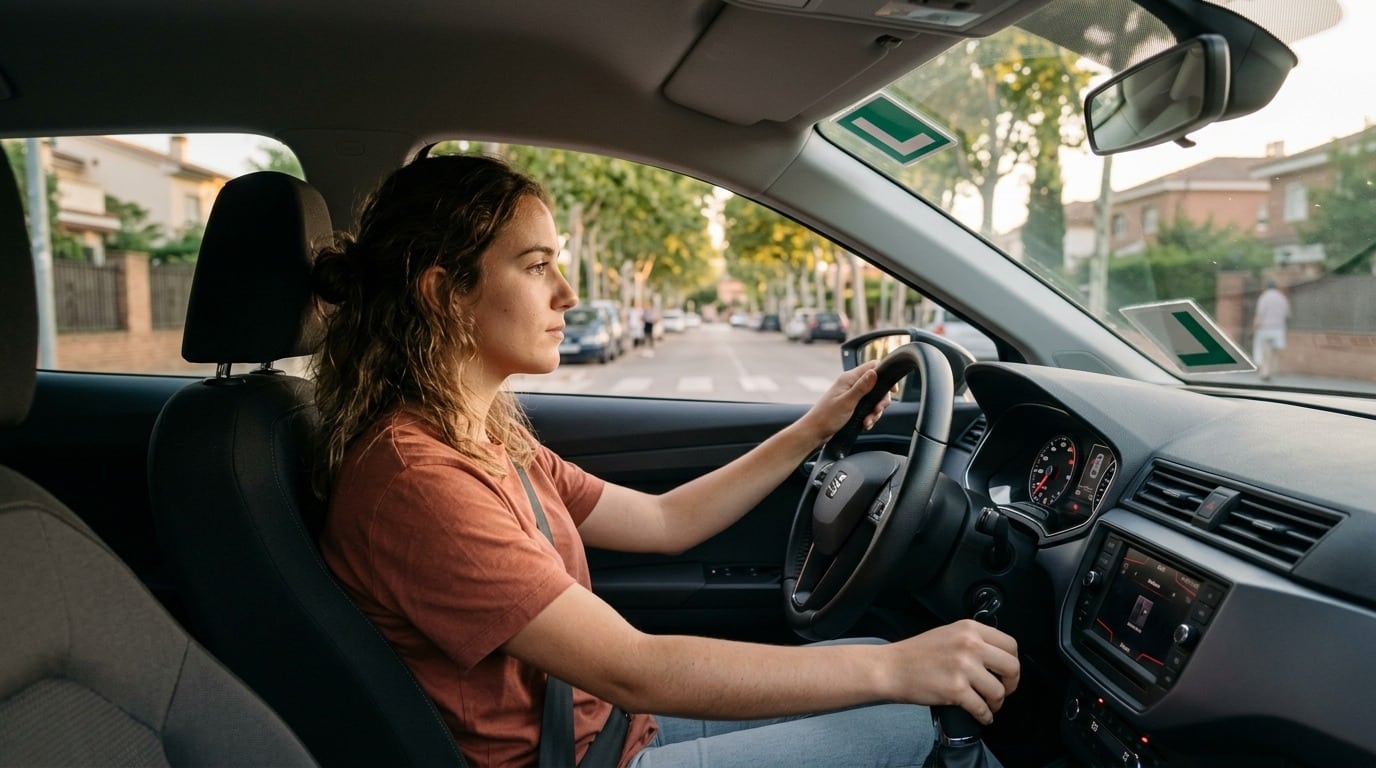
Yes, you can sit the DGT test in English. For the car licence, the Spanish traffic authority lets you take the theory exam in English, French or German as well as in Spanish and the co-official languages, and you choose it on the application form. The questions are the same ones, with the same pass mark: 30 questions, three answers each, and no more than three mistakes.
Here you’ll see which licences can be taken in English, what the exam is like, how to book it and who has to sit it at all. And since passing the theory comes first, you’ll also see how to prepare with DGT practice tests in English in the same format as the real exam.
📌 Quick Summary (TL;DR)
- The DGT test in English exists for the car licence (B) and for motorbikes (A1, A2). Trucks and buses can be sat in English or French, but not in German.
- The moped (AM) and trailer (BE) tests are only offered in Spanish and the co-official languages.
- You choose English when you apply, in the «Idioma de la prueba teórica» box of the DGT application form. If you go through a driving school, the school files it for you.
- The exam is the same in every language: 30 questions, three answers with one correct, a maximum of three mistakes and 30 minutes, on a computer.
- The fee is the DGT’s tasa 2.1, 94,05 €, and it gives you two attempts. A pass is kept for two years.
- You may not need the test at all. EU and EEA licences are valid in Spain, and licences from countries with an exchange agreement are swapped without tests for cars and motorbikes.
- A licence from any other country stops being valid six months after you become resident, at the latest. From then on you need a Spanish licence, theory test included.
Can You Take the DGT Theory Test in English?
You can. The Reglamento General de Conductores, the regulation behind every Spanish licence, says nothing about the language of the exam. What sets it is the DGT’s own application form for a driving licence, the model known as Mod. 04. It has a box called «Idioma de la prueba teórica», language of the theory test, and that’s where you pick English.
For the B licence, the one that lets you drive a car, the form offers Spanish, the co-official languages, English, French and German. So if your Spanish isn’t strong yet, you don’t have to wait until it is. You’ll sit the same test as everyone else, translated into English, at the exam centre the DGT assigns to you.
The form does limit the co-official languages by region: Catalan in Catalonia and the Balearic Islands, Basque in the Basque Country and Navarre, Galician in Galicia and Valencian in the Valencian Community. English, French and German carry no regional note.
Which Licences You Can Sit in English
English isn’t available for every exam. The same box on the form lists which languages go with which licence:
| Licence | Languages for the theory test | In English? |
|---|---|---|
| 🚗 B (car) | Spanish, co-official, English, French and German | ✅ Yes |
| 🏍️ A1 and A2 (motorbike) | Spanish, co-official, English, French and German | ✅ Yes |
| 🚚 C1, C, D1, D and their E versions (truck, bus) | Spanish, co-official, English and French | ✅ Yes, but not German |
| 🛵 AM (moped) and BE (car with heavy trailer) | Spanish and co-official | ❌ No |
| 🚜 LCM and LVA licences | Spanish and co-official | ❌ No |
For most English speakers the useful row is the first one. The B licence covers cars, and mopeds too, as our guide to what you can drive with the B licence explains (it’s in Spanish, like the rest of our blog). If your plan is to drive a moped first, or to tow a heavy caravan later, that test will be in Spanish.

What the DGT Test in English Is Like
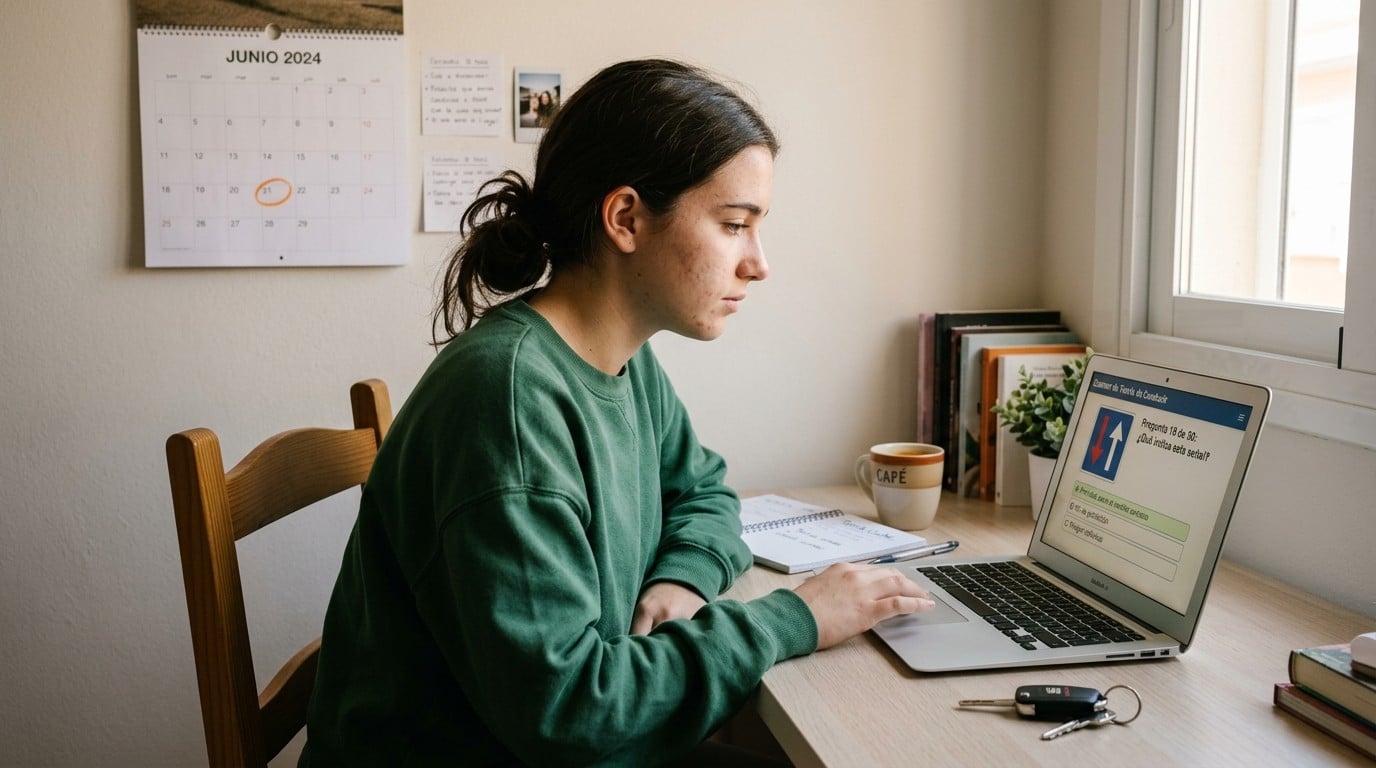
On the day, you sit at a computer and answer 30 questions, each with three possible answers and only one correct. You pass with three mistakes or fewer, and you have 30 minutes. That’s the B theory test today, whatever language you choose, and it’s how the DGT itself describes it: 30 questions with three answer options each.
The fine print comes from the Reglamento. Its Annex VI allows between 30 and 50 questions in the common test, gives one minute per question, and sets the pass mark as a maximum of 10 % mistakes, rounding up when the result has decimals. With today’s 30 questions, those rules give you the 30 minutes and the three mistakes.
You may also read that the exam is getting videos. The DGT is working on adding short hazard-perception clips before some questions, and in October 2026 it still described that update as work in progress. Its plan keeps the 30 questions and three options and gives you extra time for each video.
| What | B theory test |
|---|---|
| 📝 Questions | 30 |
| 🔘 Answers per question | 3, only one correct |
| ❌ Mistakes allowed | 3 at most |
| ⏱️ Time | 30 minutes |
| 💶 DGT fee | Tasa 2.1, 94,05 €, two attempts |
| 📅 How long a pass lasts | Two years |
Sit the exam in the same language you practise in. If you study in English and switch to Spanish on the day, or the other way round, every question costs you extra seconds just to work out what it’s asking.
aePlusTest student support
If you read Spanish, our full guide to the theory exam covers the subjects, the rules and the scoring in more depth:
How to Book the DGT Exam in English, Step by Step
The process is the same as for a Spanish speaker, with one extra choice: the language.
- Get your medical report. You need a report of physical and mental fitness from an authorised driver medical centre (centro de reconocimiento de conductores). It’s valid for 90 days, so apply before it runs out.
- Fill in the application and choose English. On the Mod. 04 form, write English in the «Idioma de la prueba teórica» box. If you sign up with a driving school, the school files the application for you, so tell them you want the exam in English.
- Pay the DGT fee. It’s the tasa 2.1, 94,05 €, and it covers two attempts. If you fail twice, you need a new application and a new fee.
- Wait for your date. The DGT assigns you an exam centre in the province where you applied.
- Bring your ID. The examiner can ask for your passport, residence card, DNI or driving licence, and without it the exam doesn’t start.
You can sit the theory test up to three months before you turn 18. Once you pass, you have two years to pass the driving test; after that, you have to sit everything again. If you want to know exactly how those two years are counted, read when the theory test expires.

Who Has to Sit It: Residency and Foreign Licences
Before you book, check that the test is really for you. To get a Spanish licence as a foreigner, the Reglamento asks you to prove normal residence in Spain, or a stay of at least six months as a student, and to have reached the minimum age, which is 18 for the B. You also can’t already hold a licence issued in another EU or EEA country.
That rule, together with the exchange agreements, means some people don’t need the test at all:
- EU and EEA licences are valid in Spain. You keep using yours, so there’s no Spanish theory test to sit.
- Licences from countries with an exchange agreement are swapped for a Spanish one. For cars and motorbikes the DGT exchanges them directly, without any tests. Trucks and buses usually need a practical test and sometimes a theory one.
- Licences from any other country stop being valid six months after you become resident in Spain at the latest. From then on, you need a Spanish licence, with the theory test and the driving test.
In two cases there’s no exchange at all: when your country isn’t on the DGT’s list of exchange agreements, and when you got your foreign licence while you were already legally resident in Spain. Either way you’ll sit the theory test, and you can do it in English.

Is the DGT Test Harder in English?
The test itself isn’t harder, because the questions and the pass mark don’t change with the language. The difference is in the reading: the English version follows Spanish traffic law, so some wording sounds stiff to a native speaker, and terms that are obvious in Spanish can look odd once translated.
The Spanish terms are worth knowing too. A few come up again and again, in the questions and on Spanish roads:
- Turismo: the legal word for a passenger car.
- Glorieta: a roundabout, which comes up in questions about who gives way.
- Arcén: the hard shoulder, where you stop in an emergency.
- Vía interurbana: a road outside a built-up area, where speed limits are different.
- Ceda el paso: give way.
If you study with Spanish material and then sit the test in English, you’ll spend part of your 30 minutes translating in your head. Keep the words above for the road, and do your mock exams in English.

How to Practise for the DGT Test in English
Start with the DGT’s own website. It has free mock tests in exam format: you choose the type of exam and the language, and at the end you see your mistakes. The DGT is open about their limits. It says there are only two or three different questionnaires per licence type, and that the tool is there to show you the type of question and the exam screen, not to prepare you.
For real preparation you need volume, in English and in the same format, and the AEOL Cloud tests in English give you that. AEOL Cloud is the test platform used by driving schools across Spain, and its B licence pass in other languages gives you the B tests in exam format in English, with a month of unlimited access to 100 % of the tests, on your computer, phone or tablet. It’s the same platform behind our Spanish courses, which you can read about on the AEOL Cloud page.
Before you buy, know that not every question comes with a written or video explanation in English: the full set of explanations exists for the Spanish version of the B licence. Use the English pass for full mock exams in the real format until you pass them with a margin.
You can prepare the theory on your own and join a driving school only for the lessons. If you’re weighing that up, our comparison of online tests and a traditional driving school breaks down what you save and what you can’t skip.

✅ Checklist: Before You Book the DGT Test in English
- You’ve checked that your foreign licence can’t simply be exchanged or used in Spain.
- You have normal residence in Spain, or six months as a student, and you’re 18 or will be within three months.
- Your medical report is less than 90 days old.
- You’ve written English in the language box of the application, or told your driving school.
- You’ve paid the tasa 2.1 (94,05 €) and know it covers two attempts.
- Your mock exams in English come out with three mistakes or fewer in 30 minutes.
- You’ll bring your passport, residence card or DNI on the day.
Thinking about a moped for your teenager? The AM theory test isn’t offered in English, so read our guide to the carnet AM.

Frequently Asked Questions About the DGT Test in English
Yes. For the car licence (B) and for motorbikes (A1 and A2), the DGT offers the theory test in English, French and German, as well as in Spanish and the co-official languages. You choose the language in the box for the theory test language (Idioma de la prueba teórica) on the application form, or your driving school does it for you.
Yes. It’s the same test translated: 30 questions with three answers each and only one correct, a maximum of three mistakes and 30 minutes on a computer. The fee, the two attempts and the two-year validity of a pass don’t change with the language either.
Get your medical report from an authorised centre, fill in the DGT application (Mod. 04) writing English as the language of the theory test, and pay the tasa 2.1 of 94,05 €. If you sign up with a driving school, it files the application, so just ask for the exam in English.
No. According to the DGT application form, the specific tests for the AM, BE, LCM and LVA licences are only offered in Spanish and the co-official languages. English is available for the B, A1, A2, and for truck and bus licences.
DGT stands for Dirección General de Tráfico, the Directorate-General for Traffic. It’s the government body that runs driving exams and issues driving licences in Spain, through a provincial traffic office (Jefatura Provincial de Tráfico) in each province.
The DGT website has free mock tests in exam format where you choose the type of exam and the language. The DGT itself says there are only two or three questionnaires per licence type and that they’re meant to show you the exam screen, so for steady practice you’ll need a larger bank of tests.
The test isn’t harder by design: questions, options and pass mark are the same in every language. Some wording follows Spanish traffic law closely, so it can read stiffly in English. Practising with tests in English before the exam gets you used to that phrasing.
Not always. EU and EEA licences are valid in Spain, and licences from countries with an exchange agreement are swapped without tests for cars and motorbikes. Any other foreign licence stops being valid six months after you become resident at the latest, and then you need a Spanish licence with its theory test.
Yes, for the B licence. The AEOL Cloud B licence pass in other languages includes the B tests in exam format in English, with one month of unlimited access. Not every question has an explanation in English; the complete explanations are in the Spanish version.

aePlusTest Team
We help you prepare the theory test on your own with the official AEOL Cloud tests, the ones driving schools use across Spain. We write up-to-date guides on traffic rules and the exam to help you pass first time.